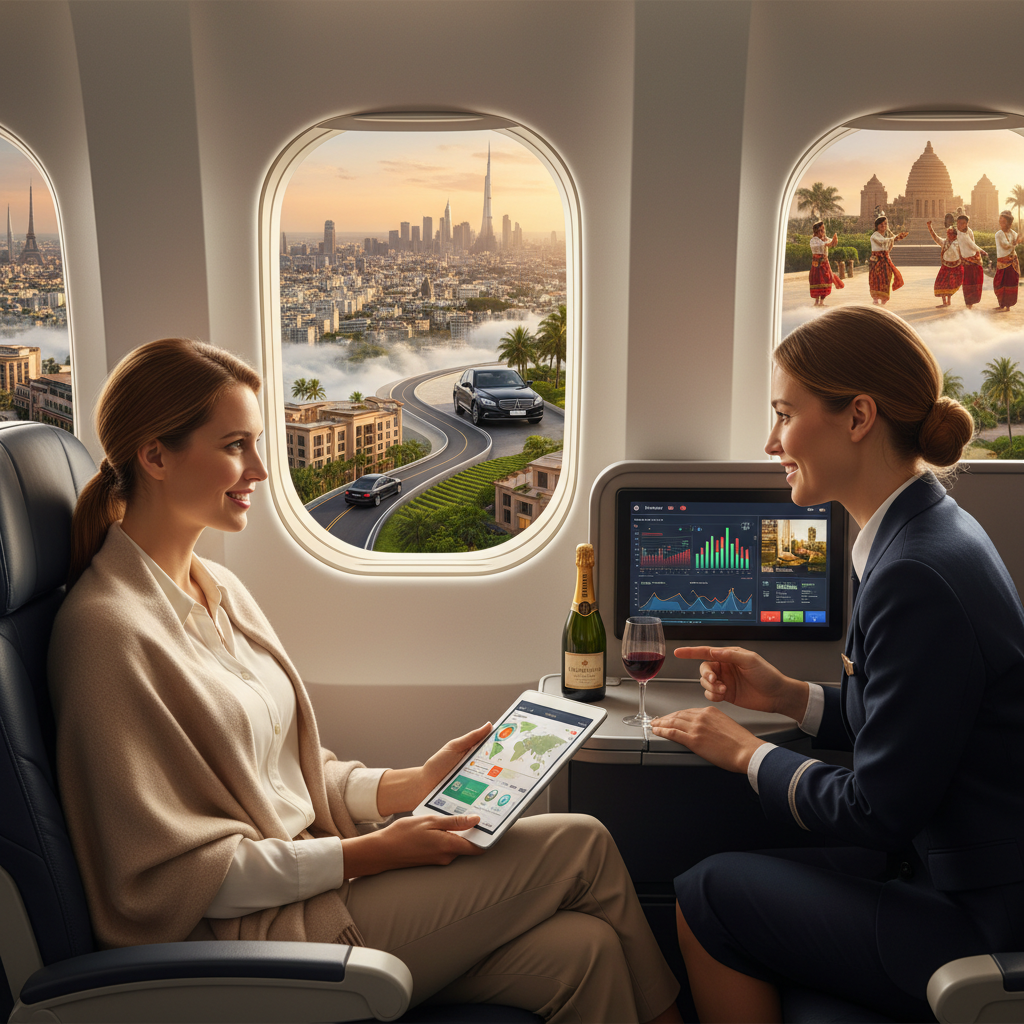
Move beyond post-tour surveys. Discover how to use 'micro-signals' and real-time pivots to drive massive secondary revenue in your tourism business.
I’ve spent the last decade in the trenches of the tourism industry, helping operators scale from "making ends meet" to generating over $10M in revenue. If there is one thing I’ve learned, it’s this: The biggest money isn’t made in the booking office; it’s made in the middle of a dusty trail, on the deck of a boat, or in the backseat of a luxury SUV.
Most operators are obsessed with post-tour surveys. They wait until the guest is at the airport to ask, "How did we do?" By then, the opportunity to blow their minds—and expand your profit margin—is gone.
If you want to move from $500 group bookings to $5,000 private upsells, you have to master the "In-Flight" Pivot. You need to stop viewing your guides as logistical babysitters and start training them as Experience Architects.
Here is how we turn real-time customer sentiment into high-ticket revenue.
The Death of the Post-Tour Survey (And the Birth of the Real-Time Pivot)
We’ve all seen it. A high-net-worth client books a "standard luxury" package. They’re polite, they’re nodding, but there’s a flicker of boredom in their eyes. Maybe they mentioned their love for vintage watches in passing, or they looked longingly at a private vineyard as the tour bus drove by.
In a traditional model, the guide sticks to the itinerary because "that’s what’s on the clipboard." In my growth framework, that’s a cardinal sin.
The "In-Flight" Pivot is about identifying micro-signals of aspiration or dissatisfaction and having the infrastructure to change the itinerary on a dime. When you solve a problem or fulfill a buried desire in real-time, the price tag becomes irrelevant. You aren't selling a tour anymore; you’re selling a memory they couldn't have bought anywhere else.
Empowering Guides with Discretionary Budgets and "Emotional IQ"
You can’t expect a guide to innovate if they’re afraid of overspending on the company credit card.
The first step in my $10M playbook is the Discretionary Magic Fund. I give my lead guides a set budget per tour—say, $200 for a standard group or $500 for a private one—that they can spend without permission to enhance a guest's experience.
- The Micro-Signal: A guest mentions it’s their anniversary, or they lament that they forgot to try a local delicacy.
- The Pivot: The guide uses the budget to arrange a surprise bottle of a rare local vintage or a private tasting at the next stop.
This isn't just "being nice." This is building the rapport necessary for the $5,000 upsell. Once a guest sees that the guide is listening and has the agency to act, the "sales" barrier drops.
The Systematic Upsell: From $500 to $5,000
How do you actually transition from a standard experience to a high-ticket add-on without sounding like a used car salesman? You look for the Aspiration Gap.
I once had a guide in Peru who noticed a couple on a standard Macchu Picchu tour were incredibly fit and kept asking about "remote" ruins. Instead of just giving them more facts, the guide called our office during the lunch break.
By the time the couple got back to their hotel, we had a proposal ready: “We noticed your interest in the off-the-beaten-path trails. We’ve secured a private helicopter and a master archaeologist to take you to a restricted site tomorrow morning.”
That was a $6,500 pivot. They took it instantly.
The Key: The guide didn't "sell" it. They identified the aspiration, relayed the data to the "closers" at the office, and we presented it as a bespoke solution to their specific interest.
The CRM Triggers: Turning "In-Field" Data into Serendipity
To make this scale, your guides need to be data collectors. If a guide learns that a guest hates crowds but loves contemporary art, that shouldn’t stay in the guide’s head. It needs to live in your CRM.
We use specific CRM Triggers to log these field notes in real-time:
- The "Passion Point" Tag: Did they mention a hobby? (e.g., Yachting, Architecture, Gastronomy).
- The "Friction Point" Tag: What did they complain about? (e.g., "The hotel was too loud," "I wish we had more time at the museum").
- The "Milestone" Tag: Are they celebrating, or perhaps scouting for a future corporate retreat?
When these tags are hit, it triggers an automated (but deeply personalized) task for the sales team. The next morning, the guest receives a text: "We heard you loved the gallery yesterday. We’ve actually cleared a private hour for you at the owner’s studio this afternoon if you'd like to dive deeper."
This feels like serendipity. To you, it’s a high-margin business process.
The 3-Step Training Module for Experience Architects
If you want your team to drive secondary revenue, you have to move them away from "Logistics" and toward "Architecture." Here is the training module I use.
Phase 1: The Active Listening Audit
Guides are trained to listen for "I wish" statements.
- “I wish we could stay here for sunset.”
- “I wish I knew more about the local politics.”
Every "I wish" is a revenue opportunity. In training, we role-play these scenarios, teaching guides to lean into these comments rather than brushing them off to stay on schedule.
Phase 2: The "Yes, and..." Framework
Borrowing from improv comedy, we teach guides never to say "No" to a reasonable request from a high-net-worth individual. Instead, they say, "Yes, we can certainly make that happen, and I can even arrange [High-Ticket Add-on] to make it truly spectacular."
Phase 3: The Stealth Handoff
The guide’s job is to plant the seed; the office’s job is to water it. We train guides on how to "pass the baton" to the concierge or sales lead.
- The Guide Says: "I'm going to talk to my team to see if we can get you that private access you mentioned. I’ll have an update for you by dinner."
- The Office Does: Prepares the itinerary change and the invoice, presenting it as a seamless extension of the journey.
Conclusion: Your Guides are your Greatest Growth Engine
In the world of high-end travel, the itinerary is just a suggestion. The real value—the 10x ROI—lies in the spaces between the scheduled stops. When you empower your guides to read the room, spend a little money to earn a lot of trust, and feed real-time data back to your sales engine, you stop being a commodity.
You become an indispensable part of their lifestyle. You become the person who makes the impossible happen.
Ready to turn your team of guides into a high-ticket sales force? Start by giving them more than a schedule—give them the permission to pivot.
Are you an operator looking to scale your revenue to $10M+? Stop obsessing over your Top-of-Funnel and start looking at what's happening on the ground. DM me today or visit my website to learn more about my Experience Architect training programs. Let's build something legendary together.