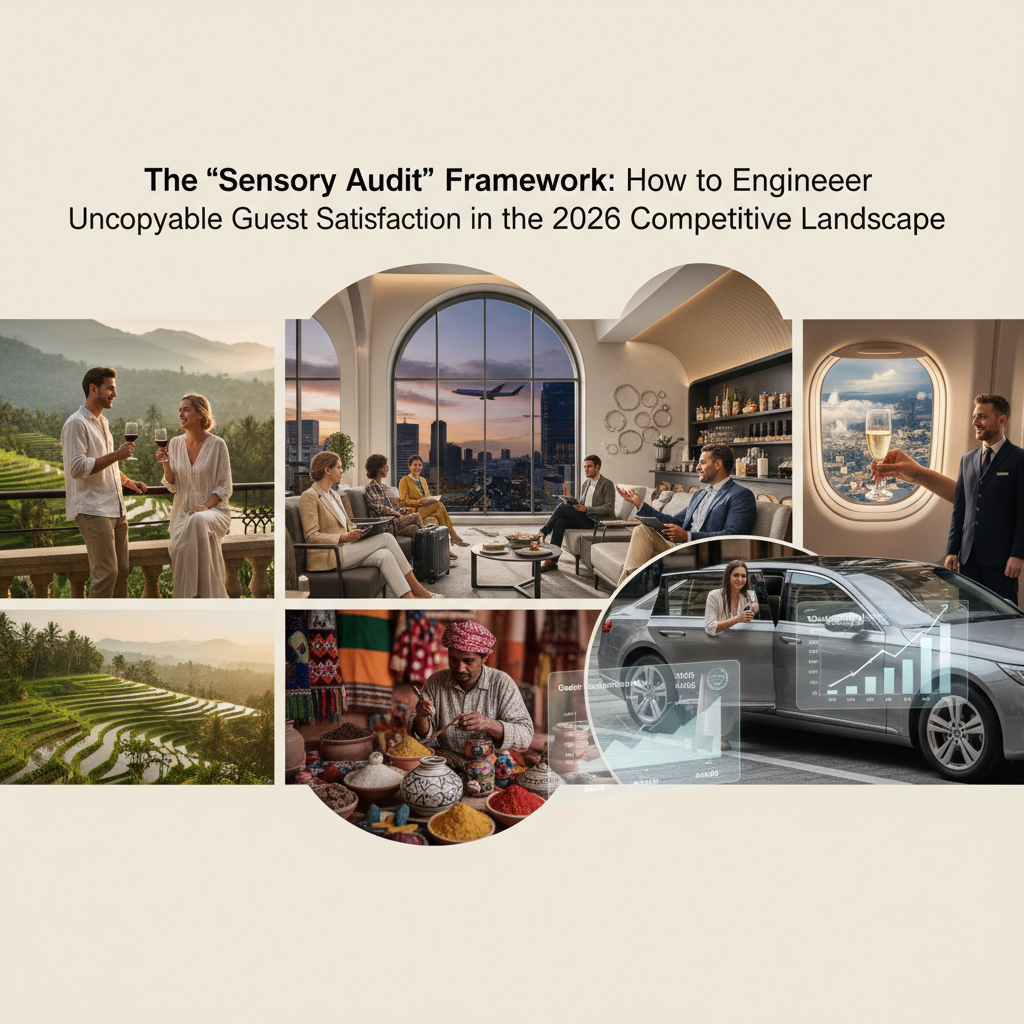
I’ve sat across the table from hundreds of tour operators, from boutique outfitters in the Andes to high-volume bus fleets in Rome. When they ask me why their growth has plateaued, they usually point to the same culprits: OTA commissions are too high, Google Ads are too expensive, or the "competition is undercuting my prices."
But here is the hard truth I’ve learned while generating $10M+ in revenue for my clients: Your problem isn't your price; it’s your "sameness."
In the 2026 travel landscape, simply showing someone a landmark and telling them a few dates is a commodity. AI-guided glasses and immersive apps can do that now. If you want to build a business that is truly uncopyable—and one that justifies a premium price tag—you have to stop selling sights and start engineering senses.
Welcome to the era of the Sensory Audit.
Why "Sight-Rich" is a Race to the Bottom
For decades, the tourism industry has been obsessed with the visual. We sell our tours using stunning Instagram photos of sunsets and mountain peaks. But here’s the catch: once the guest arrives at that "Instagrammable" spot, they are surrounded by 500 other people doing the exact same thing.
The 2026 traveler is savvy. They’ve seen the photos. They’ve watched the 4K drone footage on YouTube. They aren’t seeking a "sight-rich" experience anymore; they are starving for a "sensory-rich" one. They want to feel the grit, smell the history, and hear the silence.
Traditional customer satisfaction is no longer a "moat" for your business. It's the bare minimum. To win today, you must audit the moments your competitors are ignoring.
The Sensory Audit: A Step-by-Step Framework
When I scale an operation, I use a framework called the Sensory Audit. We literally walk through the entire guest journey—from the moment they receive a confirmation email to the moment they get back to their hotel—and we grade it across the five senses.
1. Sound: The Acoustic Buffer
Most tours are loud. Traffic, wind, or the droning voice of a guide through a cheap PA system. Tactical Fix: I once worked with a luxury van operator who couldn't figure out why his "premium" reviews were mediocre. We realized the van’s tires were noisy on asphalt. We swapped them for high-end "quiet-performance" tires and added a curated, low-frequency acoustic playlist for the transit sections. Reviews immediately shifted to phrases like "incredibly relaxing" and "peaceful."
2. Smell: The Memory Anchor
Smell is the only sense linked directly to the amygdala (the brain's emotional center). Tactical Fix: If you run a walking tour, do you lead guests past a dumpster to get to a monument? That’s a friction point. Conversely, I’ve seen operators use "scent branding" by providing guests with chilled towels infused with local eucalyptus or cedarwood during a break. That smell becomes the "anchor" for their entire vacation memory.
3. Touch: The Tactile Quality
Is your "welcome packet" a flimsy piece of printer paper? Or is it a textured, heavy-stock card? Tactical Fix: Tactile quality justifies premium pricing. During my $10M journey, I realized that if a guest touches smooth leather, cool metal, or soft linen during the day, their perception of the tour's value skyrockets. Evaluate your equipment: the handles of your kayaks, the upholstery of your seats, even the weight of the water bottle you provide.
4. Taste: Beyond the "Included Lunch"
Stop offering "ham and cheese sandwiches." Tactical Fix: Even if you aren't a food tour, taste should play a role. A small, local sweet during a historical story or a specific type of mineral water from a nearby spring creates a "taste memory." It proves you’ve curated the experience, rather than just outsourced it.
5. Sight: Managing the "Visual Pollution"
Visuals aren't just about the scenery; they're about what the guest sees when they aren't looking at the monument. Is your guide wearing a wrinkled, stained polo shirt? Is there trash in the door pocket of the van? Tactical Fix: Remove the visual noise so the beauty of the destination can stand out.
Moving from Scripts to Sensory Storytelling
In 2026, the "Standard Guide Script" is dead. If a guide is just reciting facts, they are a human Wikipedia, and tourists can find that for free.
To create uncopyable satisfaction, move to Sensory-Centered Storytelling.
Instead of saying, "This cathedral was built in 1492," teach your guides to say: "Close your eyes for a second. Can you hear the way the wind whistles through those limestone arches? That limestone was hauled by hand from 20 miles away. If you touch the wall right here, you can still feel the chisel marks from the stonemasons' tools."
This approach engages the guest’s entire brain. It creates an emotional resonance that is impossible to replicate. When guests go home, they don't say "the church was old." They say, "I felt the history under my fingernails." That is how you generate organic word-of-mouth that scales your revenue.


