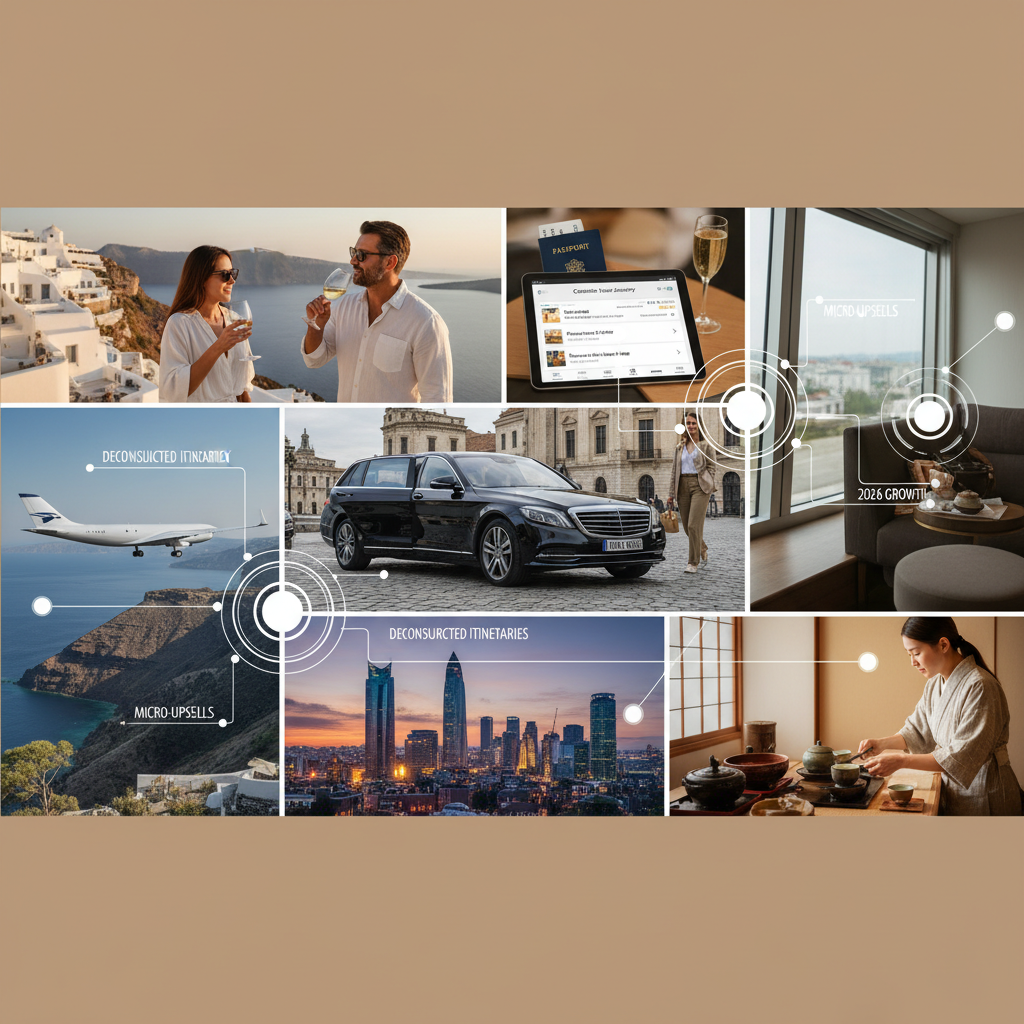
Let’s get real for a second. If you’re still trying to sell 2019-style "all-inclusive" tour packages in a 2024 economy, you’re leaving millions on the table.
I’ve spent the last decade scaling tour operations, and if there is one thing I’ve learned while generating $10M+ in revenue, it’s that the "Grand Itinerary" is dying. Not because people don’t want great experiences, but because the way they pay for them has fundamentally shifted.
We are entering the era of Experience Modularization.
In 2026, the winners won’t be the operators with the most expensive brochures. The winners will be the ones who know how to deconstruct their tours into high-margin micro-upsells. Here is how you stop fighting over price and start winning on margin.
The Inflation Wall: Why Rigid Pricing is Killing Your Conversion
We have to address the elephant in the room: global inflation. The middle-market traveler—the person who used to drop $3,000 on a week-long guided tour without blinking—is feeling the squeeze.
When you present a potential lead with a $4,500 "Gold Standard" price tag, you aren’t just selling a tour; you’re asking them to make a massive emotional and financial commitment upfront. In a volatile economy, that "all-in" price becomes a barrier. Your bounce rates go up, and your sales team spends all day defending your value proposition against cheaper, lower-quality competitors.
The old-school "bundled" approach assumes everyone wants the same level of luxury, transport, and dining. They don’t. By forcing every guest to pay for the private chauffeur and the 5-star lunch, you’re pricing out the savvy traveler who would have gladly bought the core experience and then spent an extra $500 on a photography add-on later.
Experience Modularization: The "Base-Plus" Breakthrough
Modularization is the process of stripping your tour down to its "Atomic Core"—the high-quality, non-negotiable essence of the trip—and offering it at a competitive entry price.
Think of it like the "IKEA effect" for tourism. You provide the high-quality foundation, and the customer "builds" their perfect version of the trip through layers of upgrades.
Why this works for your bottom line:
- Lower Barrier to Entry: You capture price-sensitive leads who would have otherwise ignored your "luxury" pricing.
- Psychological Momentum: It is much easier to get a "Yes" on a $1,200 base booking than a $2,500 all-inclusive one. Once they’ve booked, they are psychologically committed to the trip.
- Higher Margins: Your base price covers your costs and overhead. Your modular upsells? That’s where the 80% margins live.
The 30-Day Window: Using Automation to Trigger "Micro-Moments"
Here is the secret sauce that took my operations from steady to scaling: The pre-arrival upsell window.
Once a guest has booked their base experience, there is a magical "30-day window" before they arrive. This is when the excitement peaks and the "vacation brain" kicks in. Using AI-driven automation, you can trigger behavior-based upsells that feel like a concierge service rather than a sales pitch.
Instead of sending one boring "Are you ready?" email, my most successful clients use 24/7 automation to offer:
- The Luxury Transit Upgrade: "We see you’re arriving at 2 PM. Want to skip the shuttle and have a private Tesla waiting for $75?"
- The Content Add-on: "Want to forget your phone? Add a private photographer to your tour for $150."
- The 'Skip-the-Line' VIP Access: "It’s going to be a busy Saturday. For $40, we’ll fast-track your entry."
When these are offered one by one via SMS or email in the weeks leading up to the trip, the uptake is massive. You aren't asking for $500 anymore; you're asking for $40 here and $75 there. This is how you increase your Average Order Value (AOV) by 30% without ever changing your main product.


