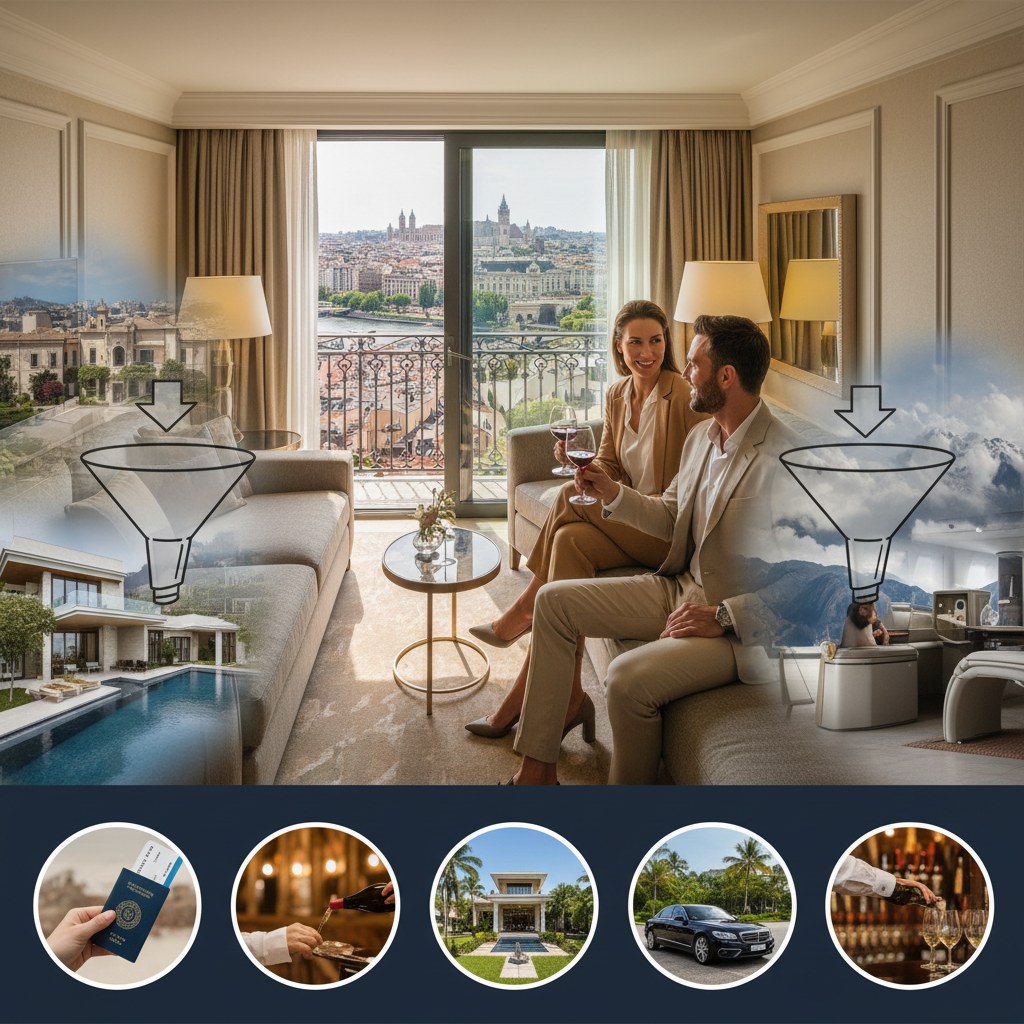
Looking at other tour operators limits your innovation. Discover how to apply luxury real estate's 'exclusive showing' model to your high-ticket travel business.
I’ll never forget the moment I realized why most tour operators struggle to scale past the "owner-operator" ceiling. I was sitting in a $15 million penthouse in Miami, not as a buyer, but as an observer of a masterclass in sales psychology.
The real estate agent wasn't selling 4,000 square feet of concrete and glass. He was selling a legacy. He was selling "the only one left." And he was doing it with a surgical precision that made our industry’s "Book Now" buttons look like amateur hour.
In my decade of scaling tour companies to $10M+ in revenue, the biggest breakthroughs never came from studying other tour operators. They came from looking outside our bubble. If you only look at your competitors, the best you can ever be is 10% better than them. But when you borrow the conversion funnels of luxury real estate, you play a game they don't even know exists.
The Innovation Trap: Why Your Competitors Are Holding You Back
Most tour operators suffer from what I call "Industry Incest." They look at the top-ranked operator on TripAdvisor, copy their itinerary layout, mirror their pricing, and use the same stock-style photography of people clinking wine glasses.
The result? Commodore-level marketing. When you look like everyone else, the traveler’s only remaining metric for decision-making is price. You’ve commoditized yourself before the first phone call even happens.
Luxury real estate agents don't have this luxury. They are dealing with high-ticket assets where the "product" is often static. To win, they have to innovate on the experience of buying. By borrowing their funnels, we shift the conversation from "What does this tour cost?" to "How do I ensure I’m one of the few who gets to experience this?"
Borrowing the "Exclusive Showing" Model
Real estate moguls never "give a tour." They host an "exclusive showing." There is a psychological weight to that distinction. In the world of high-ticket travel, we need to stop treating inquiries like customer service tickets and start treating them like applications for an exclusive asset.
Scarcity-Driven Viewing Windows
In real estate, an agent might say, "The owner is only allowing showings this Tuesday between 2 PM and 4 PM." This creates an immediate rush of dopamine and anxiety in the buyer.
For your high-ticket tours, you can apply this to your consultation calls. Instead of using a generic Calendly link with 40 open slots, limit your "Design Consultations" to specific windows.
“Gonzalo only takes three itinerary design calls per week to ensure the level of personalization required for this grade of expedition.”
Suddenly, your time is a finite resource, not a commodity.
Client-Curated Previews
High-end agents often send a "teaser" video or a curated lookbook of the neighborhood before the showing. They don't show the whole house—just the view from the master balcony.
In travel, don't send a 12-page PDF brochure immediately. Send a Client-Curated Preview. This is a 60-second personalized video or a high-impact digital lookbook that focuses on one specific "black book" element of the tour they can't find on your website—perhaps a private kitchen entry or a meeting with a local countess.
The 3-Part Follow-Up Sequence: Selling the Guide, Not the Scenery
Everyone can see pictures of the Eiffel Tower or the Colosseum on Instagram. The scenery is free. What they are paying you for is the lens through which they see it.
Real estate agents sell the neighbor and the lifestyle, not the walls. You must sell the guide. Here is the 3-part sequence I use to close $20k+ private tours:
Phase 1: The "Architect" Introduction (Day 1)
Immediately after the inquiry, don't send a quote. Send the "Architect's Vision."
- The Message: "I’ve started sketching out a route that avoids the 10 AM crowd at [Landmark]. To do this right, I’m matching you with Paolo. He’s not a guide; he’s an art historian who actually worked on the restoration of that specific site."
- The Goal: Position the guide as a subject matter expert, not a chaperone.
Phase 2: The "Unfair Advantage" (Day 3)
If they haven't booked, hit them with the "insider access" angle.
- The Message: "I caught up with Paolo today. He mentioned that since you're interested in [Specific Hobby], he can actually get us behind the velvet ropes at [Location] because of a personal connection he has. This isn't something we can offer on our standard website."
- The Goal: Build the "Only This Person Can Do This" narrative.
Phase 3: The "Window Closing" (Day 5)
Apply the real estate closing tactic.
- The Message: "Just a heads up, Paolo’s calendar is filling for those dates. Because he is our most requested specialist, I can only 'soft-hold' his time for another 24 hours. Do you want me to lock him in for your family?"
- The Goal: Force a decision based on the scarcity of the expert, not the destination.
Moving Beyond "Travel Marketing"
To reach that $10M+ mark, you have to stop thinking of yourself as a tour operator and start thinking of yourself as a High-Value Asset Manager. The "asset" is your client's most precious non-renewable resource: their time.
When you use real estate funnels, you change the power dynamic. You are no longer a vendor begging for a booking; you are an expert curate-ing an experience.
High-net-worth individuals (HNWIs) are used to being sold to this way. They find comfort in the friction of a "Viewing Window." They find value in the "Architect" introduction. If your booking process is too easy, too automated, or too "cheap-feeling," you are actually signaling to high-ticket clients that your product is average.
Your Quarterly Innovation Action Plan
Innovation is a muscle. If you don't flex it outside your industry, it withers. I challenge every operator I consult to pull one tactic from a non-travel industry every 90 days.
The Q1 Plan: The Non-Travel Swap
- Select an Industry: Look at Luxury Real Estate, Private Banking, or Bespoke Tailoring.
- Identify a Tactic: Is it their physical welcome kits? Their "By Appointment Only" entrance? Their referral-only loyalty programs?
- The "Test" Implementation: Apply it to just one of your premium products.
- Measure the Delta: Don't just look at bookings; look at the Lead-to-Close ratio and the Average Transaction Value (ATV).
When I started treating my tour inquiries like multi-million dollar real estate leads, my closing rate shot up by 40% in six months. We didn't change the destination; we changed the journey of buying it.
The world doesn't need another tour operator. It needs a gatekeeper. Use the real estate model to build your gate, and you'll find the right people will pay handsomely for the key.
Ready to Scale?
The difference between a "local business" and a "global brand" is the quality of your sales funnel. Stop looking at your neighbors and start looking at the industries that have mastered the art of the high-ticket close.