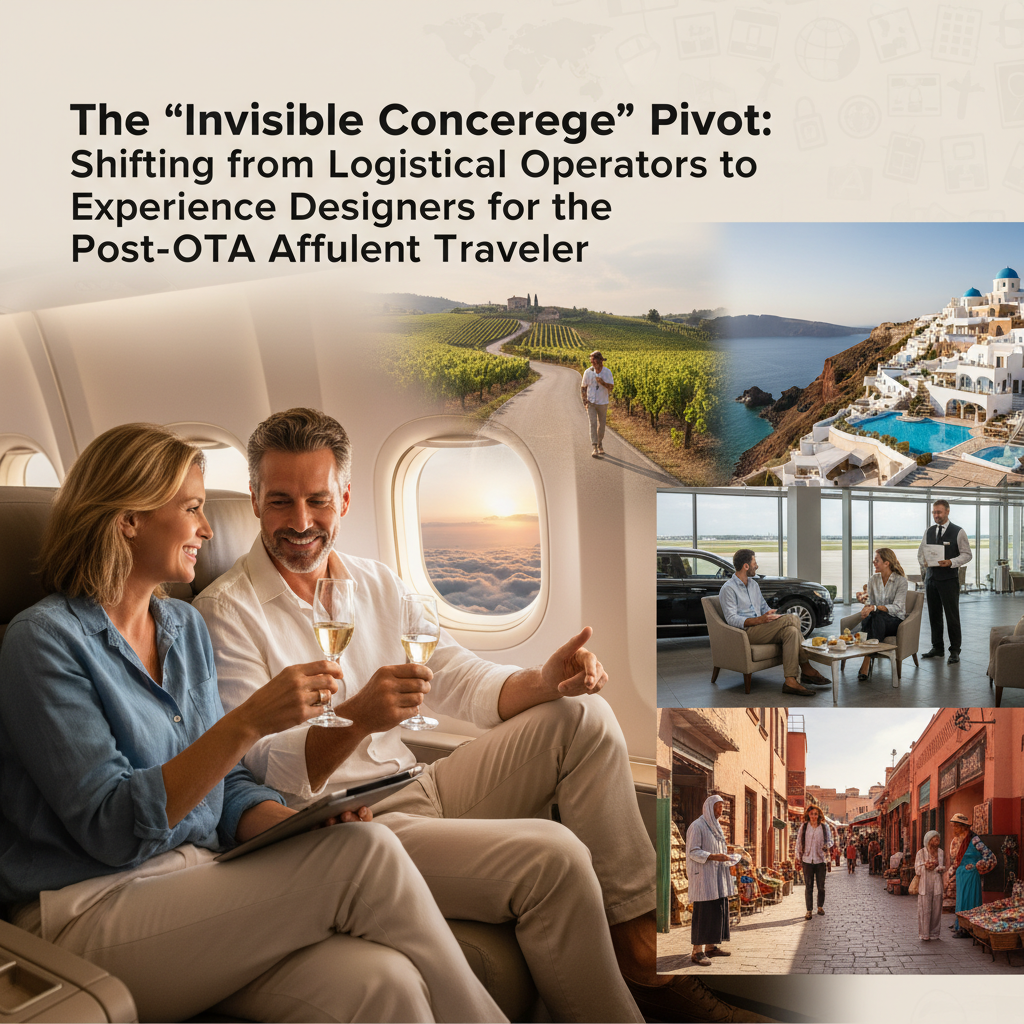
Ditch the logistics and become an Experience Designer. Here is the framework for de-commoditizing your tour business and winning the affluent traveler.
Look, I’ll be honest with you. Most tour operators are currently walking a tightrope over a pit of fire, and they don’t even realize the rope is fraying.
For the last decade, we’ve played the same game: list on TripAdvisor or GetYourGuide, optimize for "Best Private Tour in [City Name]," and pray that our transportation is cleaner and our guides are friendlier than the guy next door. It worked. I’ve seen that model scale to millions.
But for the affluent traveler in 2025 and 2026? That game is dead.
The affluent segment has "OTA fatigue." They are tired of the sanitized, mass-produced luxury that big platforms offer. To them, a private Mercedes van and a skip-the-line ticket to the Louvre isn't a premium experience—it’s a commodity. It’s a logistics play. And logistics can be automated, price-shopped, and eventually replaced by an AI with a better API.
To reach that next level—the level where I’ve helped operators generate over $10M in revenue—you have to pivot. We’re moving from being Logistical Operators to becoming Experience Designers. We are becoming the "Invisible Concierge."
The Death of Luxury Logistics (And Why OTAs Can’t Compete)
The biggest threat to your business isn't another local operator; it’s the commoditization of luxury. When an OTA puts a "Luxury Label" on a standard tour because it includes a bottle of lukewarm Prosecco, the word "luxury" loses all value.
Affluent travelers are now seeking what I call "High-Friction, High-Reward" experiences.
Think about it: anything that can be booked with two clicks on a smartphone is, by definition, low friction. If a traveler can Google it, it’s not exclusive. The gap for small, agile operators lies in the things that cannot be automated. The things that require a phone call to a grandmother in a remote village, a key to a private chapel that isn't open to the public, or a dinner in a vineyard that doesn't have a website.
This is "curated serendipity." It looks like an accident to the guest, but it’s a meticulously designed masterpiece by you.
The Gonzalo Framework: De-commoditizing Your Brand
If you want to stop competing on price, you have to change the foundation of your pitch. Stop telling people what you do. They don't care about your fleet of SUVs. They care about who you know.
In my experience, moving from a logistics mindset to a designer mindset requires three specific shifts:
1. From "What We Do" to "Who We Know"
Your value proposition shouldn't be "We provide 5-star walking tours." It should be "We provide access to the people who shape the culture of this city."
When I audit a brand’s website, I look for "Un-googleable Access." Can you get your guests into the studio of the artist whose work hasn't hit the galleries yet? Can you arrange a tasting with the winemaker, not the tasting room staff? That’s the "Invisible Concierge" at work.
2. The "Micro-Moment" CRM Strategy
Most operators use their CRM for boring stuff: booking confirmations and waivers. That’s a wasted opportunity.
The $10M+ operators I work with use what I call the "Micro-Moment" strategy. This is about capturing tiny details during the booking process—the guest’s favorite obscure jazz artist, their obsession with 18th-century botany, or their child’s love for a specific type of local pastry—and injecting a "surprise and delight" moment mid-tour.
Imagine a guest mentioning they love architectural sketches, and halfway through their tour, the "Invisible Concierge" ensures the guide "happens" to stop by a local vintage bookstore where a rare collection of sketches is waiting behind the counter for them to browse. That’s not a tour; that’s a core memory.
3. Hiring Storytellers and Psychologists, Not Just Drivers
The next generation of elite tour companies is restructuring their payroll. In the past, you hired a driver who could talk. Now? You hire a storyteller who can drive, or better yet, a psychologist who understands human behavior.
Why? Because an Experience Designer needs to read the "vibes" of a group. They need to know when to push for more activity and when the guest is silently craving a moment of quiet reflection by a river. Logistics people follow a schedule. Designers follow the energy of the room.
Designing "Curated Serendipity"
How do you practically move away from the itinerary-driven model? You build "flex-points" into your high-ticket packages.
Instead of a rigid 9:00 AM to 5:00 PM schedule, create a framework of 3-4 "tentpole" moments—the unmissable, exclusive access points—and leave the space in between intentionally vague. This allows your team to pivot based on the guest's mood.
I once worked with an operator in Tuscany. Instead of a standard "Wine and Cheese Tour," we restructured it. We told the guests, "We're going to see a friend." That "friend" ended up being a local countess who hosted them in her private garden. There was no "tour" script. It was a conversation. It felt accidental. It felt like they’d broken the fourth wall of tourism. That’s high-reward friction.
Actionable Steps: Shift Your Business Today
If you’re ready to stop being a commodity and start being an Experience Designer, here are three things you can do this week:
- The Touchpoint Audit: Map out every single time you interact with a guest, from the first email to the post-trip follow-up. Identify three places where you can add a "Magic Moment" that costs you less than $20 but feels like $200 in value. (Hint: It’s usually about personalization, not price).
- The "Un-googleable" Secret Sauce: Identify one person or place in your destination that is not on TripAdvisor. Create an experience around them. This is your "Lead Magnet" for affluent travelers who have "seen it all."
- Rewrite Your Copy: Go to your website. If your headlines are about your "Tours" or your "Vans," delete them. Replace them with stories about the feelings and the access you provide. Talk about the "Who" and the "Why," not the "Where."
The Bottom Line: Your Value is in the Invisible
The future of high-end travel isn't in better logistics. Tech will take care of the logistics better than you ever can. Your future is in the invisible threads you pull behind the scenes to make a guest feel like the protagonist of a movie.
When you shift from an operator to a designer, you stop fighting for leads on OTAs and start building a waitlist of loyal advocates who wouldn't dream of visiting your destination without you.
The $10M mark isn't reached by doing more tours; it's reached by designing better experiences. Are you ready to stop operating and start designing?
Let’s get to work. If you’re a high-growth operator looking to scale your bespoke offerings and move away from the OTA trap, let's connect. The era of the "Invisible Concierge" is here.