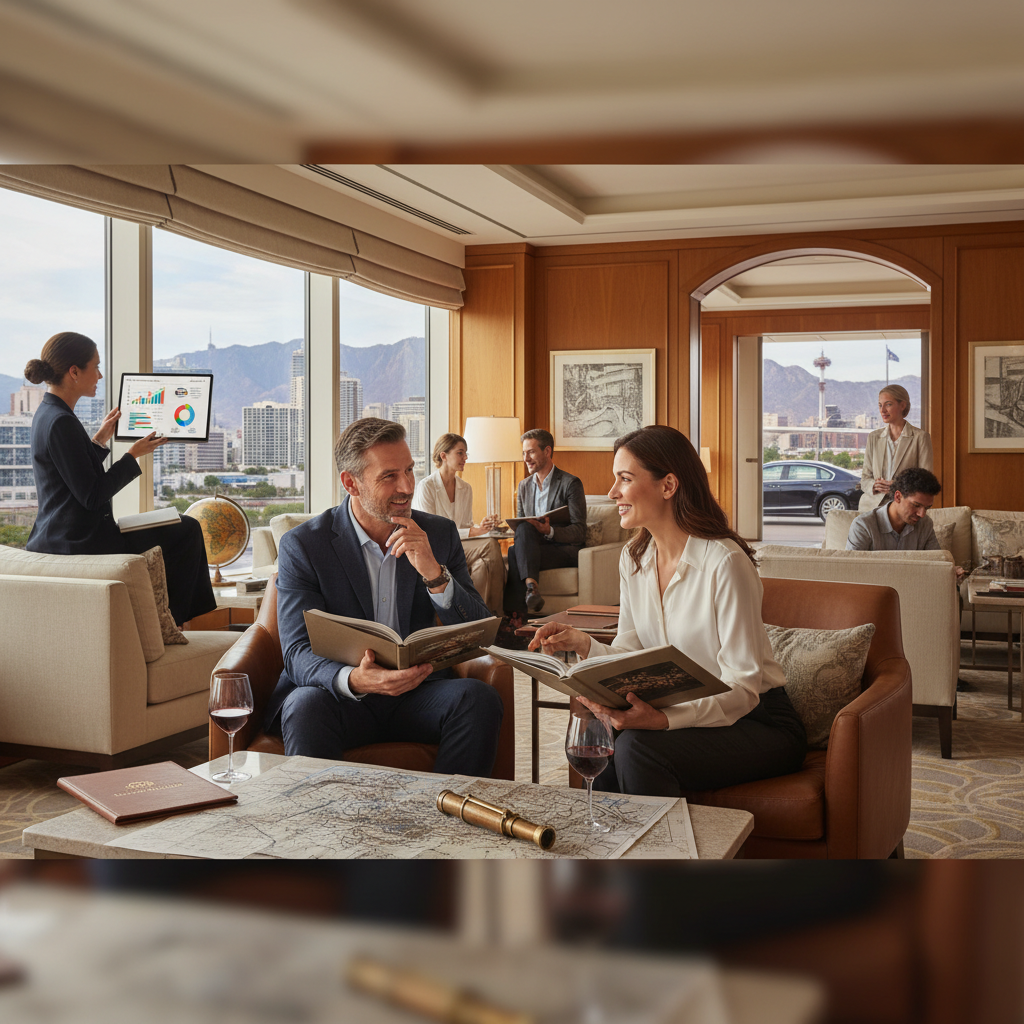
Move beyond 'VIP Access.' Learn why the future of high-ticket travel lies in Cognitive Luxury and intellectual depth.
Look, I’ve spent the last decade in the trenches of the high-ticket travel world. I’ve seen the invoices, I’ve managed the ground teams, and I’ve watched over $10M in revenue flow through experiences that range from "pretty cool" to "life-altering."
If you’re still trying to sell a $20,000 itinerary based on the thread count of the linens or the fact that you provide a Mercedes S-Class for transfers, you’re already behind. By 2026, those things won't be "luxury." They’ll be the baseline. They'll be the "given."
We are currently witnessing a massive seismic shift in what the ultra-high-net-worth (UHNW) traveler actually values. I call it Cognitive Luxury.
It’s the move away from passive observation toward intellectual exclusivity. The high-ticket traveler of 2026 doesn't want to just see the ruins; they want to be the person holding the brush alongside the archaeologist who just uncovered them.
Why "VIP Access" is Dying (And What's Replacing It)
For years, the "VIP" tag meant skipping the line, a cold bottle of Evian, and maybe a private room in a museum. But here’s the problem: anyone with a credit card can buy that now. It’s become commoditized.
The $20k+ traveler segment is bored. They are highly educated, time-poor, and "experience-saturated." They have already stayed at the Four Seasons; they’ve already eaten at the Michelin-starred spots. What they lack—and what they are willing to pay a premium for—is mental expansion.
Cognitive luxury is the transition from "white-glove service" to "deep-brain engagement." It’s the difference between a high-end tour guide and a lead preservationist. One tells you facts; the other shares a life’s work.
The $20k+ Mindset: From "Look At" to "Learn From"
Why is this happening? Because in an era of AI-generated information, context is the new gold.
When I talk to my clients who are booking these massive trips, they aren't asking about the car model anymore. They’re asking: "Who am I meeting?"
They want to spend three hours with a climatologist in the Alps discussing glacial retreat while standing on the ice. They want to sit with a master luthier in Cremona and understand the physics of a violin’s resonance. They are trading "Stop-and-Look" points for "Interactive-Expertise" modules.
This is about Identity Capital. High-ticket travelers want to return home with a new layer of expertise that they can integrate into their own worldview. They want to be smarter than when they left.
The 2026 Itinerary Audit: Replacing "Sightseeing" with "Syllabus"
If you want to survive the 2026 shift, you need to audit your current offerings. Stop looking at your itineraries as a list of stops. Start looking at them as a curriculum.
Here is my framework for auditing your travel products:
1. The Expert Swap
Look at every "Private Guide" on your list. Can they be replaced by a Practitioner?
- Old: Private guide at a vineyard.
- New: A 90-minute session with the soil scientist or the head enologist exploring the impact of volcanic minerals on the 2026 harvest.
2. The "Hand-to-Work" Test
If your guest is just standing with their hands in their pockets, the experience is failing.
- Old: Watching a glassblower in Murano.
- New: A private workshop where the guest assists in the chemical mixing of the pigments for a custom piece.
3. The Access Pivot
Is the "exclusive access" just a quiet room, or is it a conversation?
- Old: Private after-hours tour of a gallery.
- New: A closed-door discussion with the gallery’s lead restorer about the ethics of "cleaning" a 400-year-old masterpiece.
Upgrading Your CRM: Beyond Dietary Requirements
This is where most tour operators fail. Their CRM (Customer Relationship Management) system is a graveyard of "Allergic to shellfish" and "Prefers King Bed."
To sell Cognitive Luxury, you need to track Intellectual Profiles.
If you want to close a $50k booking in 2026, your sales pitch shouldn't lead with the hotel's pool. It should lead with: "Since you mentioned your interest in 18th-century naval history, I’ve secured a meeting with the maritime curator who is currently digitizing the King’s private logs."
Update your CRM fields to include:
- Intellectual Rabbit Holes: What does this client read about at 11 PM? (e.g., Regenerative agriculture, brutalist architecture, quantum physics).
- Past Learning Hits: Which specific experts did they click with on previous trips?
- Legacy Interests: What do they want their children to learn on this trip? (e.g., Financial literacy, conservation, cultural empathy).
When you know their "intellectual itch," you don't have to "sell" them anymore. You just show them how you're going to scratch it.
Marketing the Shift: Storytelling Over Glossy Photos
Stop posting pictures of sunset champagne toasts. Everyone has those. They’ve become visual noise. To attract the Cognitive Luxury traveler, your social media needs to feel like a high-end documentary, not a travel brochure.
Here are three ways to use long-form storytelling to market this shift:
1. The "Expert Spotlight" Series
Instead of a photo of a landmark, post a high-contrast portrait of one of your experts—a biologist, a historian, an artisan. Write 400 words about their obsession. Talk about the one problem they’ve been trying to solve for 20 years. Close with: "When you travel with us, this is your dinner companion."
2. The "Behind the Veil" Narrative
Share a story of an "intellectual intervention." Describe a moment where a guest’s worldview was shattered by a conversation you facilitated. Use sensory details—the smell of old parchment, the temperature of a lab. Make the knowledge feel visceral.
3. The "Why We Don't Go There" Post
Counter-intuitive marketing works. Explain why you don't take guests to the famous "Instagram spot" and instead take them to the obscure research station nearby. Explain why the research station is more exclusive, more challenging, and ultimately, more luxurious. You are signaling that you value the guest's brain, not just their camera roll.
The Bottom Line
The transition to Cognitive Luxury isn't just a trend; it's the inevitable evolution of travel. As the world becomes more accessible through screens, the only thing left that is truly "rare" is the human-to-human transfer of deep, specialized knowledge in a physical space.
If you can position yourself as the gatekeeper to that knowledge—the person who has the "Professor in the Rolodex" instead of just the "Driver in the Lobby"—you won't just increase your revenue. You’ll become indispensable to the world’s most discerning travelers.
Let’s stop selling "trips." Let’s start selling the next chapter of our clients' intellectual lives.
Are you ready to audit your 2026 itineraries? Start by looking at your most expensive tour and asking yourself: If my guest couldn't take a single photo, would they still pay for this? If the answer is no, you’ve got work to do.
Want to dive deeper into high-ticket travel scaling? Let's connect and turn your standard tours into intellectual goldmines.