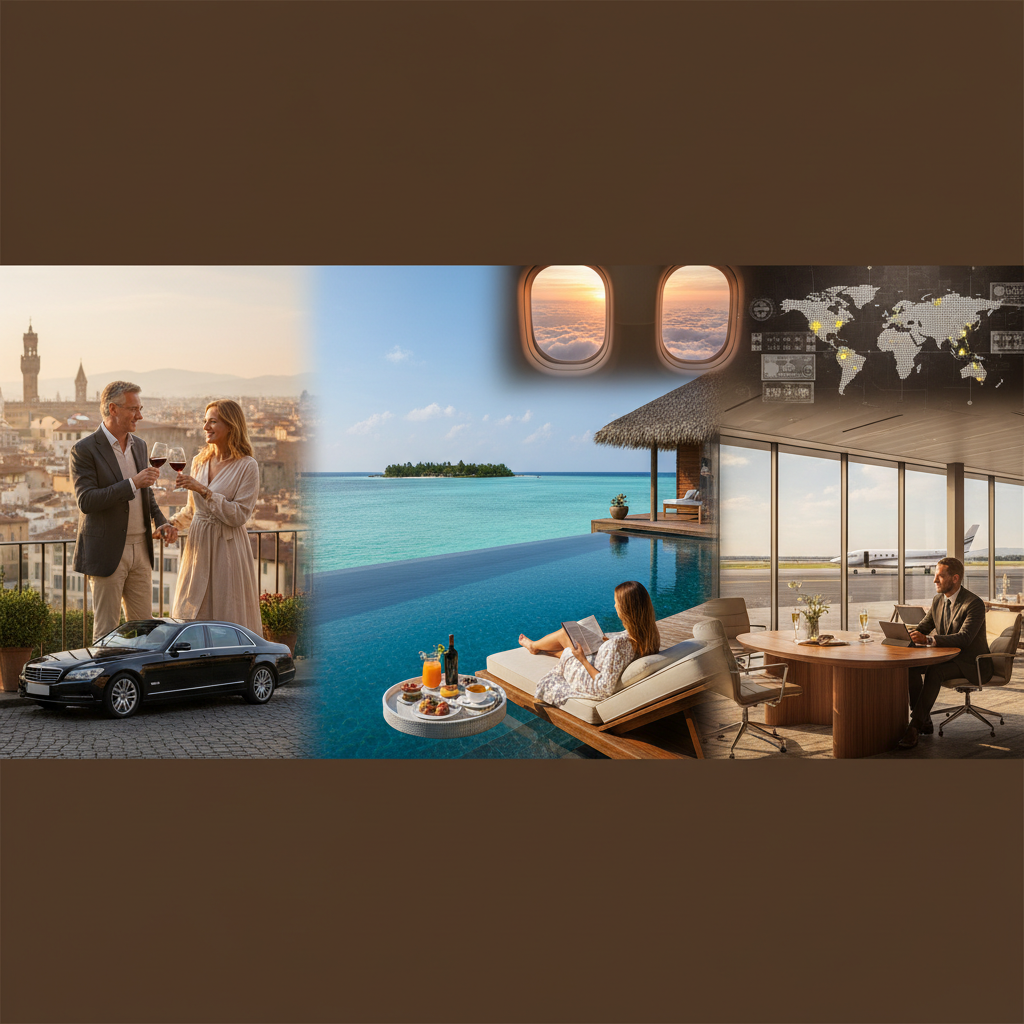
I remember the exact moment I realized that "luxury" was a dead word in the high-end travel industry. I was standing on a private dock in the Balearics, waiting for a client who had just spent $120,000 on a ten-day bespoke expedition. I had prepared the finest champagne, the gold-standard itinerary, and the most expensive transport.
He stepped off the boat, looked at me, and said: "Gonzalo, I don't want to see the stitches. I just want to feel the fabric."
That one sentence changed how I built my companies. Over the last decade, helping tour operators generate $10M+ in revenue, I’ve learned that the $100k+ traveler isn’t buying a tour. They are buying Atmospheric Wealth.
Atmospheric Wealth is the feeling that the world has been perfectly rearranged for your arrival, without you ever seeing the hands that moved the furniture. If you want to scale into the ultra-high-net-worth (UHNW) space, you have to stop selling "VIP tours" and start implementing a protocol.
Here is how we do it.
1. Beyond Status: The Psychology of the Ultra-Wealthy
Most operators make the mistake of thinking the affluent traveler wants gold-plated faucets and "exclusive" labels. While quality matters, true luxury today has pivoted from status to time-efficiency and total mental offloading.
For a client earning seven or eight figures, their most scarce resource isn't money; it’s the "cognitive load" of decision-making. Every time you ask them, "What time would you like to depart?" or "Which restaurant looks good to you?", you are charging them a tax on their vacation.
The Shift: You must move from being a "service provider" to an "architect of time." Your value proposition is: “We have already thought of everything, so you don’t have to think at all.” This requires a radical level of confidence. You aren't offering options; you are offering the singular, correct experience.
2. Invisible Logistics: Removing the 'Work' from the Journey
In the high-ticket space, the "work" of the tour—the hauling of bags, the checking of tickets, the cooling of the van—must be invisible. If a guest sees you struggling with a heavy equipment case or hears you arguing with a park ranger about a permit, the illusion of Atmospheric Wealth is shattered.
The "Zero-Heave" Rule
Your guests should never carry anything heavier than a cocktail. This sounds simple, but it requires a "shadow team." On my most successful expeditions, we often had a logistics vehicle moving 30 minutes ahead of the guests. By the time the guest arrived at a remote trailhead, the gear was set, the snacks were plated, and the "work" was done.
Frictionless Transitions
The most vulnerable part of any tour is the "transition"—moving from the airport to the hotel, or from the hotel to the trailhead. In the Atmospheric Wealth Protocol, transitions are silent. Doors are held open, climate control is pre-set to 21°C (70°F), and luggage "teleports" from the vehicle to the suite. Your goal is for the guest to feel like they are moving through a series of connected, beautiful rooms rather than traveling between locations.
3. Personalization via Intelligence: The Art of the Micro-Moment
If you ask a guest what they want, they’ll give you a standard answer. If you know what they want before they arrive, you create magic.
At my agencies, we didn't just use booking forms. We used "The Discovery Phase." We would scour public interviews, social feeds, and previous booking data to find the "Micro-Moments."
Case Study: We once had a CEO who mentioned in an obscure 2018 podcast that he missed a specific, artisanal coffee roastery from his hometown in Seattle. When he reached a remote campsite in the middle of Patagonia, his guide served him that exact roast in a French press.
That coffee cost us $30 to ship and 10 minutes of research. To the client, it was a $10,000 moment. It signaled: "We see you. We know you. You are safe here."
Actionable Tip: Create a "Guest Profile" that includes:
- Preferred hydration (still, sparkling, room temp, or chilled?)
- Allergy nuance (not just "no nuts," but "I hate cilantro")
- The "First 15 Minutes" (what do they need immediately upon arrival? A hot towel? A double espresso? Total silence?)


